
Ferme Badaoui · Doukkala, Morocco
Ferme Badaoui holds established trees, livestock, beehives and reservoirs reported to hold water after a wet winter. Abdelhamid Badaoui has returned a concrete proposal and working budget for a possible first cycle: approximately 1,290 m² of open ground and approximately 1,000 m² within an existing pomegranate orchard. These are two starting conditions within one farm. Their boundaries, sequence, operating agreement and payment readiness remain for local confirmation.
A possible Doukkala cycle may include paid local stewardship and field work, planting materials, water distribution, tools, protection, tests and proportionate documentation. Its final scope belongs in a locally held agreement and budget, not in a public allocation to one person.
Next return: connect the two starting areas to a simple water and land map for the approximately 80-hectare holding; clarify and agree the roles with Abdelhamid Badaoui and Mohamed Belbaida; and identify a lawful local recipient before any activation decision.
What is here
The site holds existing pomegranate trees, understood to have been established around 2015, now about eleven years old. Their present condition, productivity, water access, management history and soil context could be discussed and documented if Abdelhamid Badaoui and local participants decide a shared land reading would be useful.
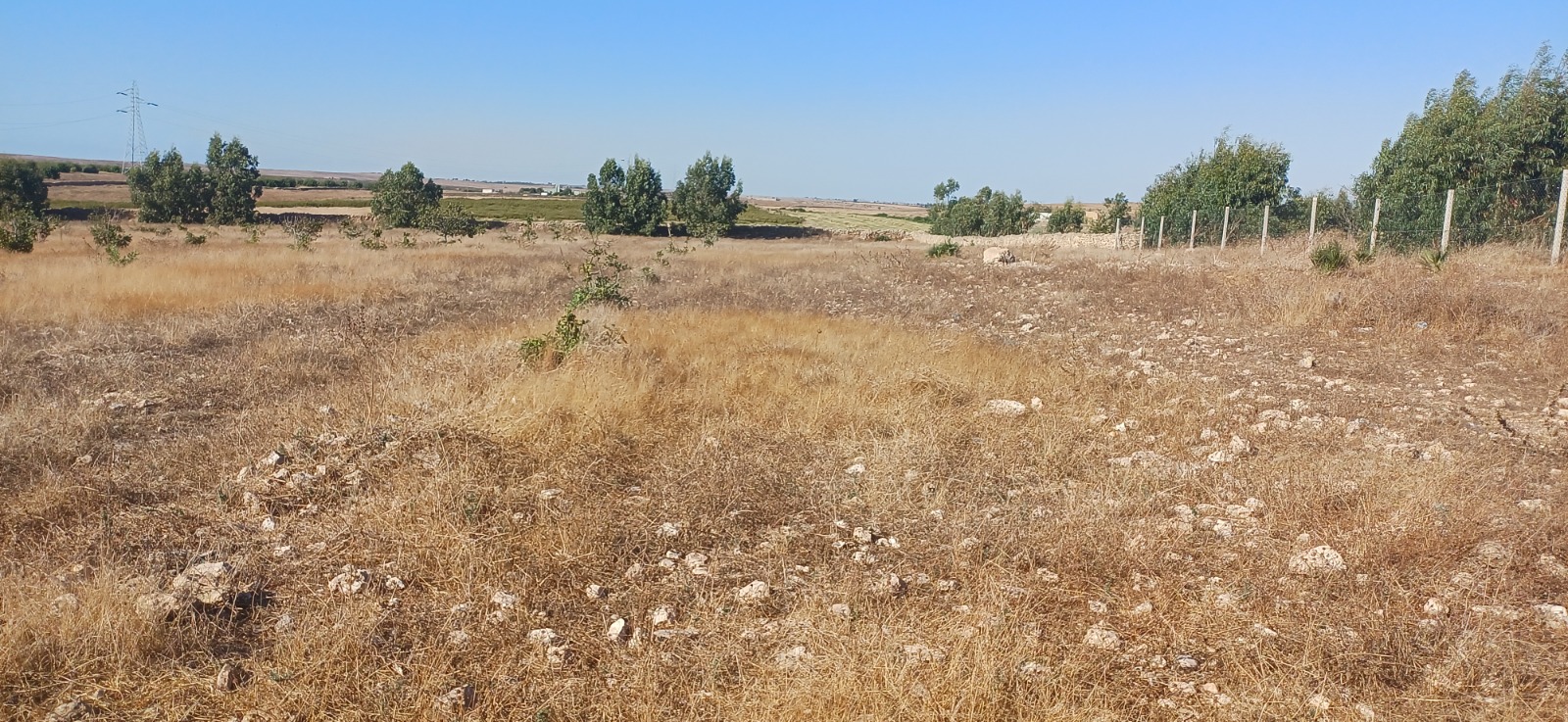
What the site also holds: stored water following a wet winter; sheep, goats and beehives, with honey among the farm's products; a working relationship with Planetary Guardians since 2021; and the practical knowledge of people who have cared for and prepared the land over years. Water availability and biological potential still need to be read through the seasons.
Working hypothesis: the existing trees may be the first incomplete chapter of a more layered food system. Their condition, water relation, management history and possible future role must be examined locally before that interpretation is accepted.
— Working hypothesis, possible Doukkala field cycle
Why this place matters
The Doukkala farm holds a specific combination of constraints and existing assets: land under pressure, established trees, stored water, livestock, bees, practical knowledge and a steward relationship. One possible first shared cycle could learn from two different starting conditions on the same farm — uncultivated ground and existing pomegranate planting — without treating them as separate field commitments. Exact scale, sequence and first movement remain subject to local agreement.
Questions about succession design, soil cover, water behaviour and steward support remain working possibilities. They become part of Spiralweb practice only if the people holding the farm shape a bounded question, receive a useful return and choose to continue.
The water condition
Reservoirs are reported to hold water after a wet winter. A first land walk can locate wells, storage, irrigation routes, slopes and existing vegetation. Stored water is a useful starting condition; its volume, seasonal reliability and relation to groundwater use need to be established locally.
The central question is not only yield. It is whether water use can fall over time while soil cover, biomass, biodiversity and steward viability rise.
A possible direction — not yet a shared design
Our interest in syntropic agroforestry begins with richer relationships between plants: different heights and seasons, food crops, shelter and biomass returning to the soil. The open area allows a new design from the beginning. The orchard asks how new species can grow alongside established trees. Wide tree spacing alone does not establish unused rooting space. New planting may also increase water demand, shade or competition. Species and density need to fit the water available and the care the team can sustain.
What the first work should make visible
A simple land and water map, an inventory of existing vegetation, suitable soil and irrigation-water tests, and records of water volumes would help establish the starting conditions. Soil texture, rooting conditions, organic matter and salt are questions for locally appropriate sampling and qualified interpretation. Existing eucalyptus and other trees can be assessed by species, location and function before decisions about their future role.
Water withdrawn from wells and water applied to the pilot areas should be recorded separately. Tensiometers may help guide irrigation when their placement, readings and maintenance are agreed. Improved litres per kilogram of harvest do not by themselves establish lower total groundwater withdrawal, and a farm pilot cannot by itself demonstrate recovery of an aquifer.
Mulch, mature organic materials, locally available biomass and any biochar trial should follow the soil reading, input quality and available resources. Small comparisons can help avoid applying an untested input across the whole area. Where feasible, comparable orchard trees under current management can provide a reference; the open ground and orchard are different starting conditions, not controls for one another.
Survival, plant condition, ground cover, useful harvest, irrigation, work and cost can be followed together. A Moroccan adviser or laboratory can help where a concrete question needs specialist knowledge. Tests and documentation belong in the budget when they assist the local work.
The next living step
The latest dialogue is bringing the field proposal and a wider learning pathway together. Abdelhamid Badaoui, Mohamed Belbaida and Spiralweb are shaping the agreement basis, with Ingrid Pullar holding a separate cross-field relationship. The next exchange can correct the boundaries, planting plan, essential tests, maintenance costs and recipient route, then price a realistic first portion against the existing budget.
The proposed sequence is to understand and prepare, establish planting with continuing care, then review and choose the next movement. A first portion need not wait for the whole budget. Each release needs an agreed scope that the available resources can sustain, including care through the first dry season where planting begins. The partnership agreement will record the work and responsibilities when these are concrete. Follow the shared learning pathway →
Questions shaping the first portion
- How are the reservoirs used, and what does the farm already know about water through the seasons?
- What do the existing trees, livestock, bees and soil cover need now?
- What can Abdelhamid Badaoui and the local group carry without adding hidden labour or cost?
Methods and evidence status
No shared funded field cycle or regular evidence cadence is active. A proposed learning pathway and working budget provide the basis for local correction; they do not yet constitute an agreed scientific baseline or an activated partnership.
Doukkala is part of the Morocco regional learning constellation alongside Had Soualem (2 ha, Assyl Elazzaoui) and Casablanca (coordination, Ingrid Pullar). Different scales. Shared learning and correction. One Morocco regional learning constellation.