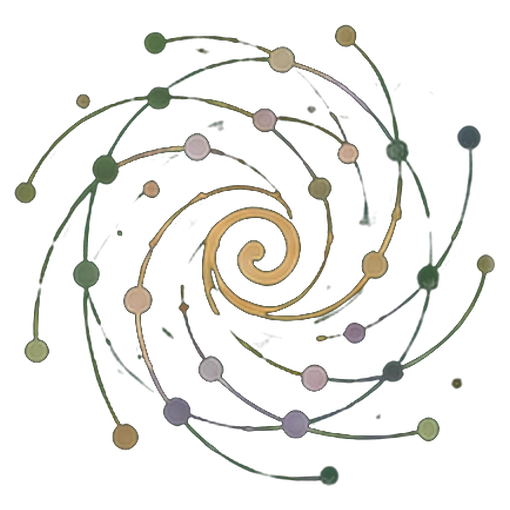
Regenerative work unfolds over seasons. People observe, interpret, decide, act, move resources and learn from what follows. Land, water, species, livelihoods and institutions also answer through consequence. The PG Ledger keeps a trace of that movement without pretending that a record is the field itself.
One situated observation, reading, decision, action or flow.
Dated records connect what was known, decided, carried and observed later.
People return, see what followed and let it correct the next movement.
What makes it a Ledger?
One entry is a record. Connected entries form a Ledger. A Ledger becomes living when people return, see what followed and let that correct what happens next.
A PG Ledger is a connected and correctable memory of what a field noticed, decided, carried and learned over time.
A PG Ledger is active only when a bounded field or relationship has:
- an agreed purpose and a legitimate human holder;
- consent, access and privacy boundaries;
- dated records connecting observation, interpretation, authority, action and resources;
- a later Return showing what followed;
- a useful rhythm fitted to place, purpose and capacity;
- a real possibility that Return can correct the next movement.
A form, dataset, Dashboard reading or project report is not yet a Ledger. The five formats may support the practice, but none activates it by itself. A notebook, conversation, photograph or measurement may be enough when it belongs to an agreed and traceable practice.
Present practice status · September 2026
No field has a regular shared PG Ledger rhythm. A local steward has begun one Applied Format in Kitgum. This is early working use, not validation, and it does not activate a Ledger. Further records should follow useful moments in the local process, not reporting journeys created for the form.
The field and the record
A living field includes land, water, species, people, histories, rights, work, institutions and consequences. It always exceeds what can be recorded. The Ledger therefore rests on three disciplines:
The living field comes before the categories used to describe it. A useful grammar directs attention, but the field must remain able to contradict it.
Observation, lived experience, local knowledge, measurement and research all have standing. Their sources, limits, uncertainty and disagreement stay visible.
The practice is bounded, consent-based and open to correction. Named people remain responsible for consequential decisions.
The field precedes the record. The record supports inquiry. Human stewards govern.
What the Ledger keeps connected
| Layer | The plain question |
|---|---|
| Observation | What was seen, heard, measured or recorded? |
| Local interpretation | What may it mean in this place and season? |
| Working hypothesis | What explanation or expectation could be tested? |
| Decision or action | What was agreed or done, by whom and under what authority? |
| Later result | What became visible afterwards, including failure and correction? |
The layers connect but should not be confused. A bare soil surface is an observation. “The soil is degraded” is an interpretation requiring context. Planting ground cover is an action. What happens after rain is a later result.
The recurring movement is simple: observe → read together → decide → act within bounds → trace resources → return → correct. It may take a day or several seasons and may pause. Return means both returning to the place and returning something useful — learning, support or correction — to the people and relationships from which it arose. Publication alone is not a Return.
Money enters this trace as capacity, not command. The Ledger can show where support came from, what conditions travelled with it, who could decide, what work or burden followed and what became visible later. It does not price the whole field or replace formal accounting.
Three conditions, kept separate
What is happening to soil, water, habitats, species, food and other living relations?
Can the people carrying the work continue without hidden exhaustion, unpaid overload or loss of livelihood and dignity?
Are roles, consent, knowledge, decisions, money, conflict and responsibility held clearly enough for trust and correction?
The streams affect one another but do not cancel one another. Ecological improvement cannot erase steward depletion. Good finances cannot excuse unclear consent. This is where Moral Biology enters the architecture: care needs carrying capacity.
Where the Penguin Dashboard is useful, each stream receives its own dated human reading:
| Reading | Meaning | Possible response |
|---|---|---|
| Green | Stable enough for the present bounded work. | Continue attentively. Green is not proof, certification or permission to expand. |
| Yellow | Strain, unevenness or emerging instability has been observed or reasonably interpreted. | Name the concern, reduce ambition where needed, make a bounded correction and observe again. |
| Red | Ordinary continuation or expansion would create unacceptable risk. | Pause the affected movement, protect against further harm and hold a named review. Repair or stabilising support may still need to move. |
| Unknown / ? | There is not enough evidence or standing for an honest colour. | Name what is unknown and seek only what is proportionate to the possible consequence. Precaution may still be needed. |
Unknown is not Yellow. It names a missing basis for judgment, not a concerning condition already observed. No reading in scope is a prior state, not a fifth colour: no legitimate relationship or agreed reason for reading exists.
The readings never average. Green / Red / Green remains Green / Red / Green. A colour is a prompt for deliberation, not a command, verdict or label. Dissent remains in the record. The Ledger remembers; the Dashboard helps people read; neither governs.
Five formats for different moments
The formats are small tools, not five stages, monthly duties or a certification route. A field may adapt, combine or leave them aside.
| Format | When useful | What it preserves |
|---|---|---|
| 1 · Steward Review Dashboard | At an agreed review point. A light monthly return is one possible default, not a universal rhythm. | Three separate readings, reasons, uncertainty, dissent, bounded next movement, responsibility and next Return. |
| 2 · Observation Sheet | When a visit, event or question makes an observation useful. | Observation and method, local or lived knowledge, interpretation, hypothesis, sources and unknowns. |
| 3 · Bounded Action Sheet | When people with standing choose one small movement. | Purpose, authority, consent, affected life, responsible holders, reversibility, stop conditions and review. |
| 4 · Governance / Decision Log | When a decision, role change, exception, revision, pause or stop should remain traceable. | Mandate, reasons, evidence, uncertainty, alternatives, dissent, conditions and route to revision. |
| 5 · Financial Ledger Sheet | When an in-scope resource flow occurs. | Source, recipient, amount, classification, purpose, evidence, privacy, stream reference and later observed Return. It complements formal accounting. |
The formats connect without forming a compulsory chain. Observation may inform a reading; a reading may lead to action, more inquiry or a pause; a decision log preserves actual authority; and the financial sheet links intention and movement to later consequence. Return is not a sixth duty. It is what allows every earlier entry to be revisited.
A human-held architecture
Explores sources, questions, versions and unfinished inquiry. It is human-held and may be AI-assisted.
Preserves the bounded, agreed and traceable memory needed by a field or relationship.
Supports a dated human reading of three separate conditions. It does not score the field.
Helps a possible movement find a legitimate holder, the right memory location, conditions and a Return.
Hold authority, make decisions, carry resources and remain answerable for consequences.
Lets bounded learning travel outward with consent and provenance. Authority does not travel automatically with it.
Spiralweb calls its practice of human–AI co-inquiry Sophia Lumen. AI may help retrieve, translate, compare, trace sources and find gaps. It cannot witness a place, infer consent, assign a final colour, approve money or action, or carry legal and moral responsibility. There is no automatic path from AI output to a field action, payment or public claim.
The whole workbench does not enter the Ledger. Local records belong first to the people, place and purpose that produced them. Protected knowledge, private experience, conflict, sensitive species and abandoned drafts may remain restricted or unrecorded. The aim is not total legibility, but enough shared memory for responsibility and learning.
Boundary. The PG Ledger is not formal bookkeeping, an audit, certification, universal indicator set, central database, live control room or authority over a field. It records authority; it does not create it.
Present field relationships
No relationship should be made to look more mature than it is. The status describes its relation to a possible Ledger, not the worth of the people or place.
| Place | Current relationship to PG Ledger practice |
|---|---|
| Kitgum, Uganda | A local steward has begun one Applied Format in a drought-response and readiness context. This is early working use, not an active Ledger rhythm or validation. Further records should follow useful moments in the local process. |
| Doukkala, Morocco | A possible place-based inquiry is being shaped. Scope, agreements, activation and observation rhythm remain open. No active dataset or shared Ledger rhythm exists. |
| Had Soualem, Morocco | A possible water-security and learning inquiry is forming around an existing local practice. No shared Ledger rhythm is active. |
| Karachi, Pakistan | An existing relationship and a possible school and food-forest direction remain at an early stage. No bounded field cycle or Ledger record is active. |
| Mexico City / Xochimilco | Arturo Flores López and Spiralweb have agreed a shared Xochimilco inquiry direction linking living territory, local stewardship, university research and urban governance. A working four-to-six-month proposal invites Universidad Anáhuac México to explore an institutional home and local participants to shape one useful bounded question. A direct relationship with participating chinampa stewards, a site, agreement, resources and any Ledger rhythm remain to be established. No shared field cycle or PG Ledger rhythm is active. |
How Spiralweb uses the Ledger on itself
Spiralweb Stewardship Association is not outside the architecture. It is its first institutional test.
The Association keeps three connected but distinct records:
- Formal accounting holds bank movements, contracts, invoices, receipts and statutory reporting.
- The relationship ledger holds purpose, agreements, authority, field movements, observations, interpretations, decisions and review.
- The public Flow view shows the reconciled movement and learning that can responsibly be shared.
Together they create a bounded public stewardship record around — not instead of — the accounts. Over time, people may follow how an intention became an agreement, a release, work in a place, an observed consequence, a correction and a next decision. Delay, hidden coordination costs, overburdened stewards, drift from purpose and the Association’s own mistakes may also become visible. That is where transparency can become learning rather than display.
Flow Desk is the Association’s light internal working surface for the next bounded movement. It locates the relationship, responsible holder, records, conditions and Return that belong together. It is not the public Flow view, a second financial ledger or an automated route from inquiry to funding.
See how Flow Desk holds One Card, One Envelope and One Return →
This makes the Ledger a membrane between the Association and its surroundings. It can register whether people and institutions question, correct, join or support the work; how resources move towards fields; what burdens arise; and whether something useful returns. Silence, delay, refusal and uncertainty are also information, not a verdict.
The public Flow view uses a precise vocabulary:
| Term | Meaning |
|---|---|
| Capacity horizon | The room a phase is seeking. |
| Received in shared flow | Reconciled contributions in the permitted collection. |
| Allocated | A Board-held intention within the shared purpose. |
| Committed / agreed | A signed or otherwise recorded obligation. |
| Released | Funds that have moved to the agreed recipient route. |
| Accounted | Expenditure supported by the appropriate records. |
| Return | What became visible, useful or necessary to correct. |
| Next decision | The bounded choice that follows. |
The terms stay separate because intention is not receipt, allocation is not release, expenditure is not effect, and a hopeful outcome is not a Return.
First Field Flow · public financial status
The shared capacity horizon recorded on 2 September 2026 is DKK 5.3 million / approximately EUR 710,000: Morocco DKK 500,000, Kitgum DKK 300,000, Xochimilco DKK 500,000 and Association capacity DKK 4,000,000. The collection account balance at 30 September 2026 is DKK 0. The Association Secretary has confirmed that no contributions, allocations, financial commitments, field releases or collection expenditure have occurred since the opening status on 2 September.
In this founding phase, most of the planning horizon supports a small organisation with paid staff to sustain field relationships, agreements, financial management, documentation and shared learning. The work begins with relationships built over several years; further field relationships can develop as people, funds and local agreements make them possible. Read more in English · Læs på dansk.
Status confirmed 30 September 2026.
This dated status is based on the Association Secretary’s confirmation. It is not a live bank balance. Protected contracts, bank details, tax information and field material remain in their proper access layer.
Using the Ledger on itself is how the Association tests whether it can do what it asks of others: keep money, purpose, authority, evidence, human capacity and consequence connected; admit what is not yet known; and let Return change the next step. The Association is not only the holder of the architecture. It is one of the fields in which the architecture must learn.
The field lives. The Ledger remembers. The Dashboard helps people read. The formats support bounded work. Named humans remain responsible.
Related primary materials
Knowing From the Ground · Moral Biology · Penguin Dashboard · Flow and Return Protocol · Sophia Lumen · The Steward’s Journey · Regenerative Reciprocity · Rule of Life · The five operative formats
Related practices: Farmer Field Schools · Conservation Standards · CARE Principles · Doughnut Unrolled · IUCN Red List · iNaturalist · Participatory budgeting.